
A 15% saving the operator signed off on — by trimming requirements, not corners
Value engineering that interrogates the operational requirements — not just the price tag.
Few spaces in a capital project carry operational demands as intense as the main kitchen of an ultra-luxurious hotel. This is the account of how a structured process brought one such kitchen back within budget — a 15% reduction, signed off by the operator — without sacrificing anything the operation genuinely needed.
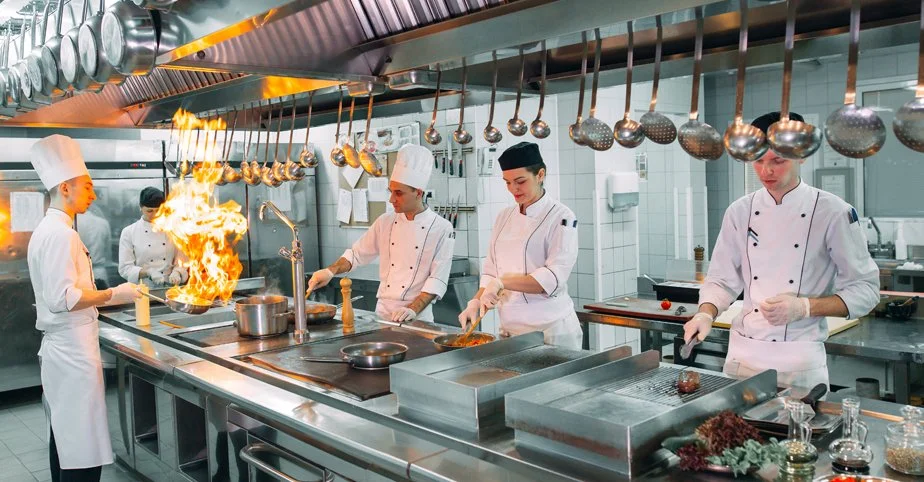
The main kitchen of a luxury hotel runs at full intensity for most of the day — a dense web of operational requirements that must all coexist in one space. (Illustrative image.)
The challenge
In a five-star hotel, the main kitchen never truly rests. Attached to the all-day dining restaurant, it serves buffet breakfast from six in the morning, à la carte lunch and dinner, and around-the-clock in-room dining — chefs cooking through the night whenever a room-service order arrives. For most of the day, it runs at the intensity of a war zone.
The operational requirements were dense and unforgiving. The kitchen had to receive fresh ingredients daily, from salad vegetables to live seafood. It had to produce soup in heavy-duty floor-standing tilting kettles capable of 250 litres a batch. It had to satisfy stringent HACCP requirements governing the flow of materials, people, and waste — raw and cooked paths kept strictly separate so cross-contamination was impossible. Grilled and cooked dishes had to be plated and held under heat lamps, served neither too hot nor too cold. And throughout, a constant volume of pots and pans had to be washed. Every one of these functions had to happen within the same kitchen — efficiently, without clash, redundancy, or overlap.
The requirements were highly complex and interdependent. Every operational need had to coexist in one space, working in concert without interference.
The initial tender came in well over budget. The future operator — already on board, and experienced in running a demanding kitchen — had specified the rooms and equipment needed for each type of food preparation. But kitchen equipment varies enormously in price by brand and origin; European and American machines can cost significantly more than their Asian-manufactured equivalents. Built on the initial specification, the tender price landed well beyond budget.
The approach
Rather than simply seeking cheaper equipment, the same four-stage method — Prepare, Listen, Reconcile, Translate — was used to challenge the operational requirements themselves.
Prepare. The operator was shown the quoted price and walked through the value-engineering process, so the exercise would be conducted together rather than imposed. Alignment was set before analysis began.
Listen. The biggest-ticket items were identified and studied in depth. For each, the underlying performance requirement was pinned down — what the equipment actually had to do. Many models carried a wide range of functions, but only some were essential to this operation. Each was sorted: must-have, good-to-have, optional.
Reconcile. Working closely with the operator, at least two alternative brands, models, or countries of origin were considered for each major item. Initial cost, warranties, and durability were compared side by side — so that any change was a reasoned trade-off the operator understood and accepted, not a saving imposed on them.
Translate. The value-engineered requirements were then captured in a structured framework and issued to tenderers. With clear, prioritised requirements rather than a fixed equipment list, tenderers could draw on their own supply chains and supplier relationships to propose alternative combinations and better offers.
The outcome
The rigorous process surfaced excessive functions, specifications, and premium brands that the operation did not truly require, and de-prioritised them. The operational requirements were trimmed to their optimal level — not cut arbitrarily, but reduced to what the kitchen genuinely needed to perform. Because the framework kept the operator involved and informed at every step — aware of each equipment choice and the reasoning behind it — the final result carried their confidence, not just their consent. The best tender received achieved a 15% reduction, signed off by the operator.
Key takeaways
Buy value, don't buy cheap. The discipline in value engineering is resisting the indiscriminate cut — dropping a specification or brand-switching just because a tenderer proposes it. Cheaper today can mean shorter warranty and lower durability, and for hard-worked equipment that's a false economy. A saving that ticks the building-budget box can quietly load far higher risk — and repair, maintenance, and replacement cost — onto the business that must operate the asset for years. The measure is lifetime operational cost, not capital price alone.
This judgement can't simply be left to the project manager. A saving the operator won't stand behind is no saving at all — it returns later as resistance, rework, or a facility that fights the people running it. But weighing capital cost against operational consequence isn't the project manager's role or training: a PM is equipped to deliver the building to budget, not to arbitrate what the operator will need to live with for years. It takes someone fluent in both — and impartial between them — to challenge the requirements with the operator rather than to them, so the result carries their confidence, not just their consent. That alignment is what makes a saving hold.
Clear requirements let the market compete for you. Handing tenderers a prioritised set of performance requirements, rather than a fixed shopping list, lets them bring their own supply chains to bear — turning procurement into a search for the best combination, not a single fixed price.